
Summit 2026 Archive
Conference Opening (Roy Dickerson) and Summit Spiritual Welcome
NAUA President Roy Dickerson welcomes all to the 3rd Summit. The text of his remarks can be downloaded here
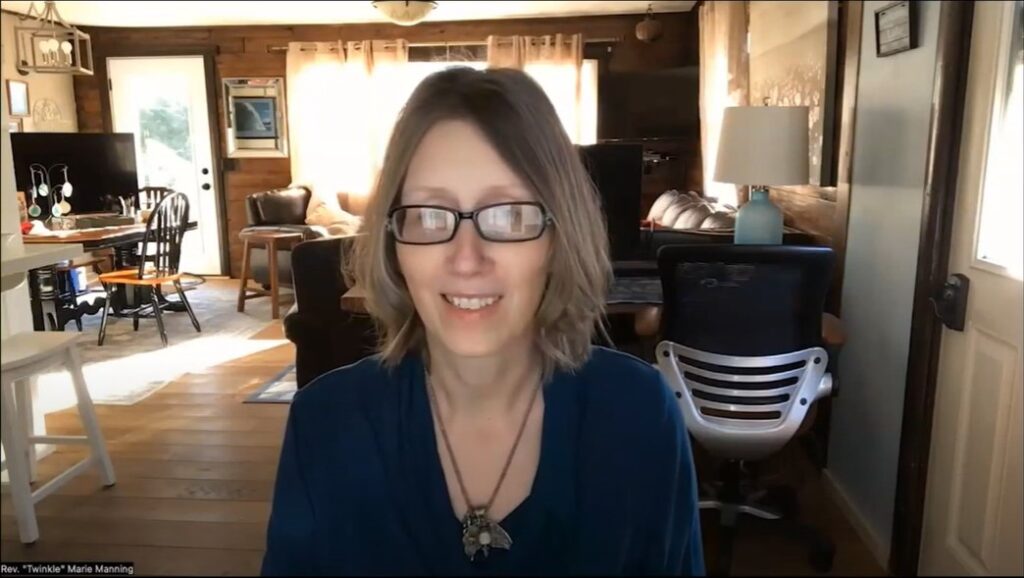
This is followed by a Summit Spiritual Welcome led by Rev. Manning.
“Spiritual Connections in a Virtual World”
In a world that is often polarized and isolating, human longing for connection is at heightened levels. This service affirms the power of virtual communities. It explores how spiritual connections in a virtual world can abate loneliness, propel resilience, create a sense of belonging and help us make meaning in the world and in our day-to-day lives. Join Us!
Rev. “Twinkle” Marie Manning is in her 5th year of serving the UU Congregation of Waterville, Maine. She is an interfaith minister, semi-retired award-winning television producer, former luxury-lifestyle magazine editor and radio show host. She is a retreat leader, podcaster and poet.
(No video for the opening session)
Online Religion: the Good, the Bad and the Ugly
Does online religion work? Which religions and type of service is thriving? Does online anonymity help or hinder religious experience? How is your experience of online religion?
Terry Anderson, PhD is a professor emeritus from Athabasca university- Canada’s Online University. His theoretical work and empirical research focused on the role of human, content and machine interaction in online learning contexts.
The slides from this talk can be downlloaded here.
Liberal Religion for the 21St Century
🔹 “Reimagining Liberal Religion Without Losing Its Soul”
How do you evolve practices and messaging without dissolving identity or principles?
🔹 “From Institution to Movement: The Future of Liberal Religion”
Should liberal religion move away from congregations toward networks, communities, and ideas?
🔹 “Can Liberal Religion Compete in a Meaning Marketplace?”
Explore how people seek meaning today (wellness, self-help, activism) and where liberal religion fits.
🔹 “Clarity vs. Inclusivity: Can You Have Both?”
A discussion carrying on from an the July Academy session with Sunil Wijeyesekera and other members of the NAUA Academy Advisory Board.
Principles as Foundations / Principles Process Overview
Why articulate formal principles for an organization? Do they help or hinder?
An overview of the current NAUA Principles process including the results from recent surveys of NAUA members.
See Principles and Foundations page for what will be presented at the Business Meeting Saturday afternoon.
Speakers – Terry Anderson and Lincoln Baxter
Spirituality for All (Theists, Atheists, Agnostics)
🔹 “What Do We Mean by ‘Spiritual’—and Do We Still Need the Word?”
Unpack the meaning of spirituality in a post-theistic, pluralistic context.
🔹 “Shared Practices Without Shared Beliefs”
How can people with radically different metaphysical views still practice and even ‘worship’ together meaningfully?
🔹 “Awe, Wonder, and Meaning with and without God”
Explore secular pathways to transcendence and meaning.
🔹 “Speaking Across Belief: Conversations That Don’t Collapse”
Practical tools for dialogue between theists, atheists, and agnostics.
Panelists Bob Simoni, John Wunderlin and Rev Alex Holt.
Principled Living & Morality in a Relativist World
(Interactive session on navigating moral disagreement without fragmentation)
🔹 “Is Everything Relative? Rebuilding Moral Confidence”
How can liberal religion articulate moral clarity without dogma?
🔹 “Human Dignity: A Foundation or a Preference?”
Examine whether core values can be grounded in something more than consensus.
🔹 Reason, Emotion and Ethics: How are moral decisions actually made and how should they be made?
🔹 “How do we practice tolerance around differences in values and personal conscience, and when is tolerance inappropriate?
A panel discussion moderated by Sunil Wijeyesekera with authors Frank Casper, author of Used to Be UU: The Systematic Attack on UU Liberalism, and Republican Theocracy; David Cycleback author Against Illiberalism: A critique of illiberal trends ; DeAndra Beck Ph.D.
What is Liberal Religion???
WHAT IS LIBERAL RELIGION? – with Joyce Francis
We all struggle with explaining our liberal religion. Rev. Bruce Bode, Minister Emeritus of Quimper Unitarian Universalist Fellowship in Port Townsend, WA, developed a 3-page handout for newcomers during his tenure, 2004-2018, and it continues to inspire us at our new Salish Sea Fellowship. In it, he lays out the “Core Ideas of Religious Liberalism.” I have come to think of it as the “bible” of our fellowship, and I will share it for your consideration and discussion.
Dr. Joyce Francis plays a leadership role in The Salish Sea Fellowship and serves on the NAUA Academy advisory board.
Science and Liberal Religion in the 21st Century
One of the key motivations that helped develop liberal religion in the 19th and 20th centuries was the desire to accommodate the newly emerging knowledge of the physical world through science and the new critical scholarship about religious texts.
This presentation will outline a vision for how liberal religion and humanism could re-orient around scientific and empirical findings from newly emerging biological sciences, in four domains. First let’s embrace a radically revised view of our evolved human nature, as is being uncovered through brain science; second let’s revise our thinking about our place in the natural world as revealed through ecology. These, together with an understanding from social sciences of how human societies can flourish will lead us to more meaningful personal relationships and more effective approaches to social justice.
Mark Reimers is a neuroscientist at Michigan State University, and a humanist leader; he is also a member of the NAUA board.
Community without Conformity by Helen Pluckrose (Keynote)
Liberalism as a Higher Order Value feels especially relevant as we proceed with our discussions about introducing a set of NAUA principles.“Liberalism should be regarded not as one value among many, but as the higher-order value that allows people with deeply different political values to disagree productively and resolve conflict without coercion or force.”
Helen Pluckrose is an independent author and journalist living in London, England. For the past decade Helen has been publishing and leading programs and initiatives that challenge authoritarianism and illiberal actions – both on the right and on the left.
The text of Helen’s talk can be downloaded here.
Annual General Meeting Vote on Vote on Principles and Foundations
Join us as we celebrate last year’s challenges and successes, review past year’s financial documents, learn from committee chair reports, elect our new Board of Trustees. and vote on a proposed set of Principles and Foundations
For the agenda for the Business Meeting see: Business Meeting Agenda
Experiential Religious Practices
🔹 “Guided Awe: Finding Transcendence in Everyday Life”
Short guided experiences + reflection (nature, music, memory, etc.)
🔹 “Embodied Presence (Even on Zoom)”
Gentle practices using breath, posture, and awareness to create grounding.
🔹 “Story as Sacred Practice”
Participants share short personal stories and reflect on meaning-making.
🔹 “Ritual Without Dogma: Creating Meaning Together”
Group co-creates a simple ritual in real time.
🔹 “Personal Spiritual Practices”
Rev Alex Holt, Rev Kenneth Marino, Joanne Kretteck, and Mary Bennett will guide us through a number of religious experiences in a virtual environment.
Summit Closing Celebration
The closing session of the conference will bring participants together to reflect on the ideas, questions, and insights explored throughout our time together and consider what they mean for the future of liberal religion. Through a combination of reflection, conversation, and shared inspiration, we will explore how reason, compassion, freedom of conscience, and openness to new knowledge can shape vibrant religious communities in a changing world. The session will invite participants to carry the spirit of inquiry and connection beyond the conference, renewing our commitment to building a liberal religion that welcomes diverse perspectives, embraces both science and spiritual exploration, and encourages each of us to live with greater hope, courage, and purpose.
Led by Joanne Krettek